
Bayesian Calibration of the Intelligent Driver Model
Chengyuan Zhang, Lijun Sun
IEEE Transactions on Intelligent Transportation Systems (2024). Volume 25(8). Pages/article 9308-9320.
Publisher record · BibTeX · All publications
What does Bayesian IDM calibration add to a single best fit?
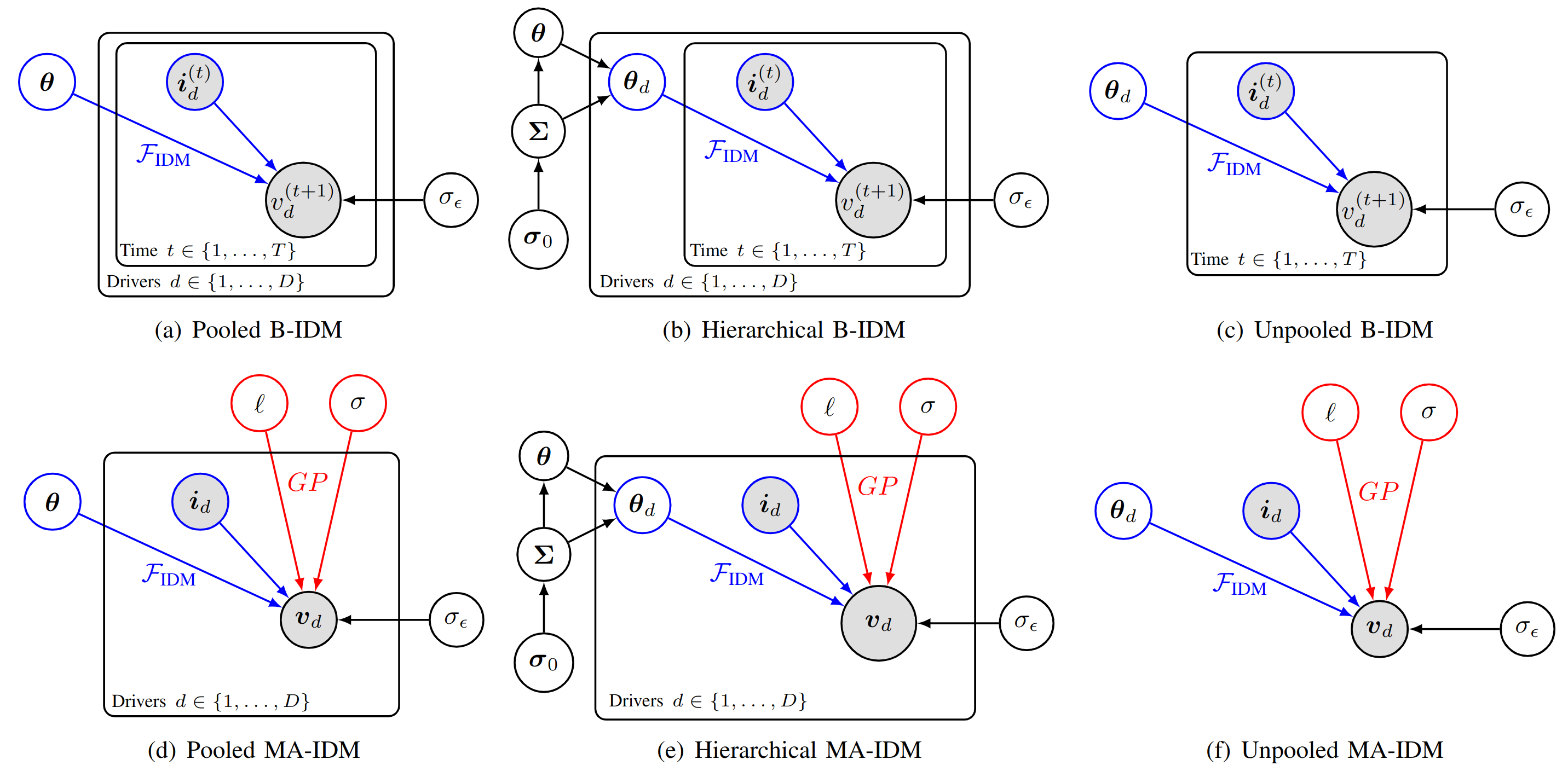
Hierarchical Bayesian inference represents uncertainty in IDM parameters, while a Gaussian process models temporally correlated discrepancies in memory-augmented IDM.
Abstract
Accurate calibration of car-following models is essential for understanding human driving behaviors and implementing high-fidelity microscopic simulations. This work proposes a memory-augmented Bayesian calibration technique to capture both uncertainty in the model parameters and the temporally correlated behavior discrepancy between model predictions and observed data. Specifically, we characterize the parameter uncertainty using a hierarchical Bayesian framework and model the temporally correlated errors using Gaussian processes. We apply the Bayesian calibration technique to the intelligent driver model (IDM) and develop a novel stochastic car-following model named memory-augmented IDM (MA-IDM). To evaluate the effectiveness of MA-IDM, we compare the proposed MA-IDM with Bayesian IDM in which errors are assumed to be i.i.d., and our simulation results based on the HighD dataset show that MA-IDM can generate more realistic driving behaviors and provide better uncertainty quantification than Bayesian IDM. By analyzing the lengthscale parameter of the Gaussian process, we also show that taking the driving actions from the past five seconds into account can be helpful in modeling and simulating the human driver's car-following behaviors.
Full abstract from the linked arXiv version, checked 2026-09-13. The bibliographic record above identifies the journal publication; the abstract is the preprint text.
Research summary
A posterior distribution describes parameter uncertainty conditional on the observations, prior, and model. This paper combines hierarchical Bayesian IDM calibration with a Gaussian process for residual dependence, producing memory-augmented IDM (MA-IDM).
The HighD evaluation compares MA-IDM with Bayesian IDM using independent errors. This separates uncertainty about parameters from temporal dependence in the discrepancy between model predictions and observations.
Is a posterior interval the same as variation in future driving?
No. A parameter posterior represents uncertainty about parameters. A predictive distribution additionally reflects the model’s stochastic process and how simulated states evolve. Both depend on the model and data assumptions.
Where should I start?
Use the calibration reading guide to connect the model to hierarchical models and autocorrelation. The reference repository contains Bayesian IDM, MA-IDM, and dynamic IDM implementations.
Research poster · Presentation · Dynamic regression extension