
Markov Regime-Switching Intelligent Driver Model for Interpretable Car-Following Behavior
Chengyuan Zhang, Cathy Wu, Lijun Sun
arXiv preprint (2025).
Preprint record · BibTeX · All publications
How are latent driving regimes different from traffic scenarios?
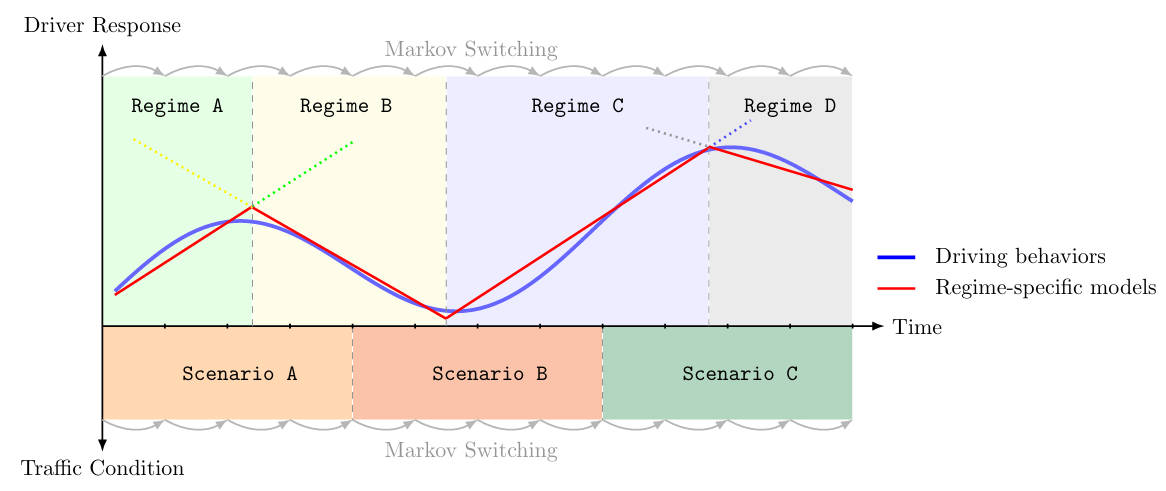
FHMM-IDM uses separate latent Markov processes for driving behavior and traffic scenarios, with regime-specific IDM parameters inferred jointly from trajectories.
Abstract
Accurate and interpretable car-following models are essential for traffic simulation and autonomous vehicle development. However, classical models like the Intelligent Driver Model (IDM) are fundamentally limited by their parsimonious and single-regime structure. They fail to capture the multi-modal nature of human driving, where a single driving state (e.g., speed, relative speed, and gap) can elicit many different driver actions. This forces the model to average across distinct behaviors, reducing its fidelity and making its parameters difficult to interpret. To overcome this, we introduce a regime-switching framework that allows driving behavior to be governed by different IDM parameter sets, each corresponding to an interpretable behavioral mode. This design enables the model to dynamically switch between interpretable behavioral modes, rather than averaging across diverse driving contexts. We instantiate the framework using a Factorial Hidden Markov Model with IDM dynamics (FHMM-IDM), which explicitly separates intrinsic driving regimes (e.g., aggressive acceleration, steady-state following) from external traffic scenarios (e.g., free-flow, congestion, stop-and-go) through two independent latent Markov processes. Bayesian inference via Markov chain Monte Carlo (MCMC) is used to jointly estimate the regime-specific parameters, transition dynamics, and latent state trajectories. Experiments on the HighD dataset demonstrate that FHMM-IDM uncovers interpretable structure in human driving, effectively disentangling internal driver actions from contextual traffic conditions and revealing dynamic regime-switching patterns. This framework provides a tractable and principled solution to modeling context-dependent driving behavior under uncertainty, offering improvements in the fidelity of traffic simulations, the efficacy of safety analyses, and the development of more human-centric ADAS.
Full abstract from the linked arXiv version, checked 2026-09-13. The bibliographic record above identifies the preprint.
Research summary
A single set of IDM parameters can average over distinct driving behaviors. FHMM-IDM instead uses regime-specific parameters and two latent Markov processes to represent behavioral regimes and traffic scenarios separately.
These regimes are inferred model states. Labels such as acceleration or steady following summarize their fitted behavior; they should not be read as direct measurements of a driver’s psychology. The preprint evaluates interpretable regime structure on HighD trajectories.
What is the distinction between a behavior regime and a traffic scenario?
A behavior regime describes how the driver responds; a traffic scenario describes the surrounding operating conditions. The model gives these two factors separate state sequences. This distinction makes it possible to inspect their temporal relationship rather than force both into one classification.
Technical note and inference equations · Research poster · Stochastic driving behavior